Where are we NOW, how’d we GET HERE, and where do we wanna GO next?
and
Who ARE we, who do we NEED to be, and who might we ASPIRE to be?
As the current ruling species on this planet that, in my opinion, are not such a bad bunch most of the time, or at least some of the time we’re not so bad… I think these are important questions to ask.
“If I read this sentence, this story, or this word with pleasure, it is because they were written in pleasure.” If anyone has written with pleasure, creating sentences that are near-orgasmic for the reader, it is Roland Barthes. The first time I picked up one of his books, called The Pleasure of the Text, I was encapsulated in it, aroused by a dead guy talking about words:
“In perversion (which is the realm of textual pleasure) there are no “erogenous zones” (a foolish expression, besides); it is intermittence, as psycholanalysis has so rightly stated, which is erotic: the intermittence of skin flashing between two articles of clothing (trousers and sweater,), between two edges (the open-necked shirt, the glove and the sleeve); it is this flash itself which seduces, or rather: the staging of an appearance as disappearance.”
He captures the little truths we rarely admit aloud:
“We do not read everything with the same intensity of reading; a rhythm is established, casual, unconcerned with the integrity of the text; our very avidity for knowledge impels us to skim or to skip certain passages (anticipated as “boring”) in order to get more quickly to the warmer parts of the anecdote… we boldly skip (no one is watching) descriptions, explanations, analyses, conversations … the author can not predict tmesis: he cannot choose to write what will not be read. And yet, it is the rhythm of what is read and what is not read that creates the pleasure of great narratives: has anyone ever read Proust, Balzac, War and Peace, word for word? (Proust’s good fortune: from one reading to the next we never skip the same passages).”
I think maybe that’s why I bold the most important stuff in my blog. Put your hand anyone who reads every word?
Yesterday I stumbled across another couple of Barthes’ books. This one from 1977, A Lover’s Discourse, unmasks the words lovers say, and the feelings that live behind them.
He describes the ‘socially irresponsible’ words “I-love-you” that ‘does not transmit a meaning, but fastens onto a limit situation’ and which most of the time one says in hope of hearing the words returned.
He talks about the suspense incurred during the ‘absence of the loved object’ which ‘tends to transform to an ordeal of abandonment’ and ‘the sigh for bodily presence’.
He talks about jealousy, saying it is ‘ugly, is bourgeois: it is an unworthy fuss, a zeal’.
He talks about contact, ‘when my finger accidentally…’ how one in love ‘creates meaning, always and everywhere, out of nothing, and it is meaning which thrills him: he is in the crucible of meaning. Every contact, for the lover, raises the question of an answer: the skin is asked to reply.’
He talks about being ‘in love with love‘.
He talks about the desire to be engulfed, be it in ‘woe or well-being’ – a craving for the intensity of the ‘outburst of annihilation which affects the amorous subject in despair or fulfillment.’
Agree with his opinions or not, they are written in a way one can’t help be wooed into reading just a little more.
And so, as I edit the book I wrote long ago, I will try to follow Barthes’ advice and ‘seek out this reader (must cruise him) without knowing where he is…’ and from there try to create with words ‘a site of bliss.’
Three years ago, before I went back to uni, I voted Liberal. Why? Three reasons: (1) Because my Dad voted Liberal. (2) I wasn’t interested in Politics. (3) I didn’t know the difference between Liberal and Labour (Australia’s Right and Left). Not a good place for any voting citizen to be. And certainly not the best intellectual place for a person who has just enrolled in a Master of Arts. But that was why I was there. I felt an abyss of lacking knowledge and a desire to try to fill it.
I thought in case some of you are in this place it might be worth sharing some of my notes.
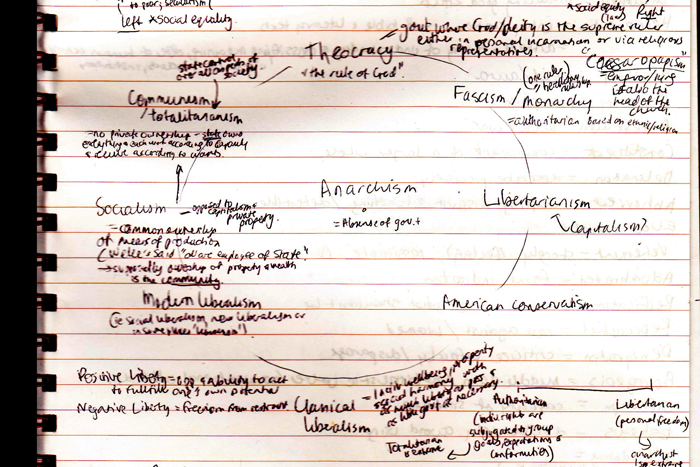
Some definitions, and possibly a more accurate and simple model is the continuum above – showing Left to Right.
The picture blow locates key political ideas in a circular diagram, with left and right to the sides, classical liberalism on the bottom, theocracy at the top, and anarchism in the middle. I’m not sure if this is completely accurate, so please let me know if you think some elements might be put around different ways. I’m actually not sure what inspired this, or how I came to locate these where they are.
Of course, as with any definitions, words carry different meanings in different contexts, different places and at different times – as this clip of Noam Chomsky talking about Anarchism, Libertarian Socialism and the development of “renting out our labour”:
I am assisting the teaching of a master’s subject called The Political Economy of Conflict and Peace, at the University of Sydney this semester. My first presentation was yesterday and in the lead up to it I drowned myself in the political economic papers and books I wrote or read over the last couple of years. And searching YouTube for parts of documentaries that I have found useful in the past. This entry has become a bit of a dumping ground for me to refer and share again at later times… maybe you’ll find some of this random collection of thoughts and clips useful too…
The global economy today:
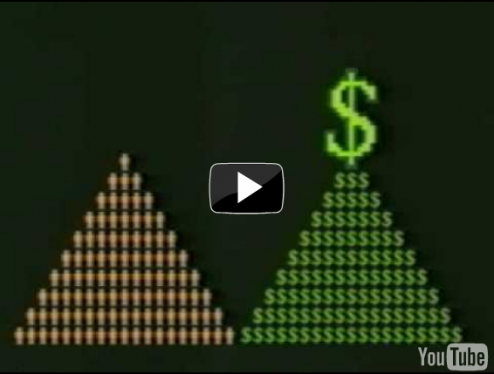
What does today’s global stage look like? I.e. What is the shape of today’s political/economical/social pyramid: tall or flat? What do people’s lives look like at the extremes?
How do the different stories, of individuals, groups and nations, told from different perspectives, from realist to liberal to marxist and all those in between, help us understand the dynamics of key actors and their sets?
Three basic theories based on three key actors:
Realism – analyses the world as states acting on their self-interests
Liberalism – analyses the world as individuals acting on rational self-interests
Marxism – analyses the world as classes acting on their rational self-interests
In The Structural Theory of Imperialism (a World Systems Theory), Johan Galtung describes a Conveyor Belt between the periphery of the Periphery (pP) pumping resources through to the periphery of the Core (pC) – this is clear to anyone who travels to places like South America, who grow the best coffee beans, sell them to the “north” for cheap and buy them back in the form of the horrible Nescafe Instant, which is all that is generally on offer to the citizens. Crazy! Same goes for all cash crops from cocoa to cotton, which prevent these people from growing food for themselves, causes slavery and human trafficking,
Demystifying Economics – Jim Stanford explains how the Booms and Bust are a necessary part of the system, and why it is the people at the very top of the pyramid who are bailed out, while the people with mortgages and jobs are the ones that have to pay.
Simms shows that on our current trajectory it would take 15 planets’ worth of earth’s biocapacity to reduce poverty to a state where the poorest receive $3 per day. In other words ‘we will have made Earth uninhabitable long before poverty is eradicated.’[1]
Did you know that half of all world trade currently passes through tax havens? Apparently they ‘allow rich people and corporations to stash trillions in assets that could provide governments with at least $250 billion a yearin tax revenues.’[2]
“At the heart of the story are two groups: the American neo-conservatives and the radical Islamists. Both were idealists who were born out of the failure of the liberal dream to build a better world.These two groups have changed the world but not in the way either intended. Those with the darkest fears became the most powerful. Together they created today’s nightmare vision of an organised terror network. A fantasy that politicians then found restored their power and authority in a disillusioned age. Those with the darkest fears became the most powerful. The rise of the politics of fear begins in 1949 with two men whose radical ideas would inspire the attack of 9/11 and influence the neo-conservative movement that dominates Washington. Both these men believed that modern liberal freedoms were eroding the bonds that held society together. The two movements they inspired set out, in their different ways, to rescue their societies from this decay. But in an age of growing disillusion with politics, the neo-conservatives turned to fear in order to pursue their vision.”
This three part documentary traces the rise of Neo-Conservativism in the U.S., with “disillusioned liberals” like Irving Kristol and Paul Wolfowitz looking to Leo Strauss’s political thinking to come together with Dick Cheney and Donald Rumsfeld. Neo-conservatives come to power under the Reagan administration, using fear to unite the citizens (and unite with the radical Islamists) in a war against the Soviet Union. It traces this alongside the radical Islamist movement back to Sayyid Qutb’s visit to the U.S. to learn about their education systems but sees the “corruption of morals and virtues in western society through individualism” and returns to Egypt to and starts the movement. Qutb is executed in 1966 and one of his followers, a–Zawahiri, later becomes the mentor to Osama bin Laden. Then of course, the two radical groups then face each other head on in the “War on Terror”.
A much shorter and funnier version of the above: Pirates and Emperors
The Eagle and the Condor (the meeting of the Mind and the Heart, of Masculine and Feminine, of the knowledge and wisdom of our world, from Western individualism, to Eastern collectivism, to Indigenous connection to the land)
1. Change corporation law – redefine “corporation” so that they are NOT treated as separate entities in their own right that can be declared bankrupt in and of themselves. Corporation law must be adjusted to hold shareholders responsible for monetary and non-monetary profits and loss.
2. Change finance / stock market laws – in implementing the above, the ST money market would probably have to go, as would trading Derivatives and Options. The stock exchange would slowdown and be based on long term investments.
3. Change banking laws for money/debt creation and collection – limit their ability to print money via debt, decrease bank’s profits, and maybe all debt cancels after 50 years, I’m not sure. Something needs to be done to regulate them though.
4. Change balance of power in the WB, WTO and IMF – give more votes to the poorer nations and create fairer trade policies
5. Create international tax laws – to crack down on tax havens.
Personally:
6. Philosophically, a self-examination of our values – what makes a life “good”? Two shifts: shift from valuing capital to valuing creativity; and shift from EGO to ECO.
7. Women might reconsider what they find attractive qualities in men – see the attraction of a creative and caring man over a rich and selfish man. Then maybe men will change in suit.
8. Write letters to corporations telling them you won’t buy their product until they stop slave trade and ridiculously low paying 80-hour weeks in sweatshops, and treat their workers in a way they would like to be treated.
9. Public shame of the ridiculously rich – unite in an attempt to decrease the obesity of the rich, and as a consequence decrease the hunger of the poor.
10. See what we might be able to do to campaign to change the laws above.
Essentially I’m talking about setting a limit to the lifestyle of those at the very bottom and very top to the pyramid. There’s nothing wrong with inequity. As my friend said, “if you wanna work smart and hard and eat lobster all the time, and if I wanna work little and eat noodles, then that’s cool. But we both should have food and shelter. It’s just a matter of cutting out the extremes and increasing social mobility between the classes.”
[1] Andrew Simms, ‘Trickle-Down Myth’, New Scientist (18 Oct 2008). p. 49. Andrew Simms is the policy director of the New Economics Foundation in London. In this article Simms steps through the mathematics to show the system is designed such that for the poor to get ‘slightly less poor, the rich have to get very much richer’. This means it would take ‘around $166 worth of global growth to generate $1 extra for people living on below $1 a day’.
[2] Susan George, ‘We Must Think Big’, New Scientist (18 Oct 2008). p. 51.
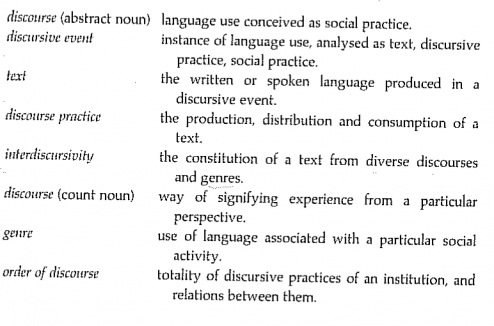
Critical Discourse Analysis is a study of LANGUAGE, IDEOLOGY, POWER and SOCIAL CHANGE. ‘Discourse analysis is not a “level” of analysis as, say, phonology or lexico-grammar, but an exploration of how “texts” at all levels work within sociocultural practices,’ says Candlin in the Preface to Fairclough. If you didn’t already gauge from the title then take this as your warning: this entry contains high levels of academic language. It is also disjointed and includes a lot of quotes (because I’m lazy).
‘One crucial conditionfor social interaction in general and talk in particular is that people understand each other. This is possible only if we assume that social members have socially shared interpretation procedures for social actions, for example, categories, rules and strategies.’ (Dijk, 1985:2)
Critical Discourse Analysis is one of the “tools” I mentioned a few entries ago that can be useful for understanding the “taken for granted” systems of knowledge that we use in order to communicate. As such it helps us view the world in a more reflexive way – which not only makes people watching more interesting, it empowers us to interact with our reality in new and wonderful ways…
Critical Discourse Analysis involves looking at the “texts” that make up our realities, questioning their assumptions, identifying underlying ideologies, the connection between language and social-institutional practices, and how these connect to formation and maintenance of power structures (like The Pyramid).
These so-called “texts” range from books to movies, TV commercials, news stories, dinner conversations, education, parent-child relations, business meetings, and jokes. A “text” in this context is anything involving a communicative language – verbal and non-verbal.
Learning about this tool illuminates the ginormous impact that “texts” that surround us have on our lived experiences; how they operate as the key forces behind both maintaining status quo structures, and the initiation of social change.
Critical Discourse Analysis is intended to ‘critique some of the premises and the constructs underlying mainstream studies in sociolinguistics, conversational analysis and pragmatics, to demonstrate the need of these sub-disciplines to engage with social and political issues of power and hegemony in a dynamic and historically informed manner… to re-engage with central constructs of power and knowledge, and above all, ideology, to question what is this “real world” of social relations in institutional practices that is represented linguistically.’ (Fairclough, 1995:viii)
Critical Discourse Analysis might look at labels like “terrorist” and “counter-terrorist”, or “ally” and “enemy”… and examine not only the term, but how it is used by different people in different ways. The definition and use of terms such as these are clearly dependent upon which side you are on.
What might this tell us about the propaganda techniques of Neo-Conservatives? Or could this clip itself be propaganda against them?
So… what does Critical Discourse Analysis involve?
Dijk explains that ‘a typical ethnographical analysis of speech events features, for example, a description of the discourse genre, the overall delimination, social function, or label of the whole speech event, the topic (theme or reference), the setting (time and physical environment), the different categories for participants, the purpose of the interaction, the type of code (spoken, written, etc.), the lexicon and the semantics, the grammar (also at the discourse level), the sequences of acts (both verbal and nonverbal), and the underlying rules, norms or strategies for the actions or the whole event… And even this enumeration is not complete.’ (Dijk, 1985:9)
‘The method of discourse analysis includes linguistic descriptionof the language text, interpretationof the relationship between the (productive and interpretative) discursive processes and the social processes.’ (Fairclough, 1995:97)
Fairclough refers to Mandel (1978) to describe the “postmodernist” features of “late capitalist” discourse that includes “post-traditional relationships” with relationships based upon authority in decline, both in the public and personal domain, for example, when it comes to kinship and self-identity ‘rather than being a feature of given positions and roles’ they are ‘reflexively build up through a process of negotiation’. Also the development of a “promotional” and “consumer” culture – with our strong emphasis on market and consumption rather than production. It is difficult not to be involved oneself in promoting because it’s part of so many people’s jobs and because it self-promotion is now part of our personal identity. (Fairclough, 1995:137-8).
Fairclough is calling for a critical social and historical turn. ‘It would seem vital that people should become more aware and more self-aware about language and discourse. Yet levels of awareness are very low. Few people have even an elementary metalanguage for talking about and thinking about such issues. A critical awareness of language and discursive practices is, I suggest, becoming a prerequiste for democratic citizenship, and an urgent priority for language education in than the majority of the population (certainly of Britain) are so far form having achieved it.’ (Fairclough, 1995:140).
Textual analysis involves two complementary types of analysis: linguistic and intertextual – that are a ‘necessary complement’ to each other.
‘Whereas linguistic analysis shows how texts selectively draw upon linguistic systems (again, in an extended sense), intertextual analysis shows how texts selectively draw upon orders of discourse – the particular configurations of conventionalised practices (genres, discourses, narratives, etc.) which are available to text producers and interpreters in particular circumstances…’ (Fairclough, 1995:188)
Texts are dependent on society and history in the form of the resources available but intertextual analysis is dynamic and dialectical in that the texts themselves can ‘transform these social and historical resources,’ “re-accentuate” genres and mix genres in texts. ‘Language is always simultaneously constitutive of (i) socialidentities, (ii) socialrelations and (iii) systems ofknowledgeand belief – though with different degrees of salience in different cases.’ (Fairclough, 1995:131)
Fairclough suggests developing “Critical Language Awareness” (CLA). It is important to try to increase the reflexive capacity of individuals.
Fairclough describes education as not only ‘a key domain of linguistically mediated power’ but is also a ‘site for reflection upon and analysis of the sociolinguistic order and the order of discourse’ by equipping learners with a critical language awareness as a ‘resource for intervention in and the reshaping of discursive practices and the power relations that ground them, both in other domains and within education itself.’ (1995:217)
With mass media generally acknowledged as the ‘single most important social institution in bringing off these processes in contemporary societies’ Fairclough recognises that ‘wealsolive in an age of great change and instability in which the forms of power and domination are being radically reshaped, in which changing cultural practices are a major constituent of social change which in many cases means to a significant degree changing discursive practices, changing practices of language use.’ (1995:219)
I think its encouraging to remember that society and culture are ALWAYS changing, language is ALWAYS evolving, and power structures are ALWAYS shifting. And I suppose we should be thankful that developed capitalist countries exercise their power typically through ‘consent rather than coercion’, ‘ideology rather than through physical force’ and through ‘the inculcation of self-disciplining principles rather than through the breaking of skulls’. If I’m going to be controlled, I definitely prefer it to be in this way.
References:
Norman Fairclough, Critical Discourse Analysis : The Critical Study of Language (London ; New York: Longman, 1995).
Dijk, Teun Adrianus van, Handbook of Discourse AnalysisBook 3, (London ; Orlando: Academic Press, 1985).
Do you ever sit there, on a park bench, at the beach, or even out of your car window, and simply observe the people that walk by? What are they wearing? What do their facial expressions and body language tell you? Do you ever put words in other peoples mouths? Guessing what they are talking about.
A couple bickering. “Why are you always like that?” “You never listen.” “That’s because all you do is complain…”
A dude trying to pick up a chick. “How you doin?” “Piss off!” “Come on…” “Seriously, piss off!”
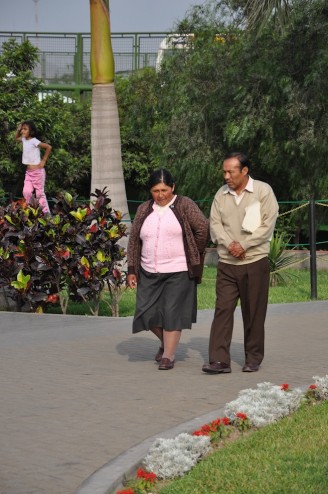
In a park in Lima, Peru, there were none of such stories. Everywhere I looked I saw stories of love:
An elderly couple reminiscing the past.
A young couple planning their future.
“You know what I’m going to do for you tonight?!”
It can be fun to imagine what is going on in others’ worlds. These interpretations tend to be based on things that have gone on in our own world, either things we have experienced directly through relationships and events, or indirectly through television shows, movies, books etc.
If you do this, then you are a social scientist, an anthropologist, a studier of people. For anyone who enjoys a little people watching, the tools I will share over the next week or so will allow you to gain deeper insights to the things you observe – both in your observations of others, and in your observations of your self.
Earlier this year I was writing about some of the gaps that I have observed:
– a gap between education at school and real life
– a gap in how knowledge is distributed between rich and poor, between academia and public, between governments and their people…
– a gap between those who gain the monetary profit from corporations and those held responsible for the corporations’ non-monetary costs to people and environment
Some of my entries over the next couple of months will be looking at how these gaps might be bridged. I will be approaching challenge by looking at the materials I’ve been researching these last six months, trying to interpret the academic jargon into everyday langugae, and apply it to everyday situations, like the people-watching scenario above.
A word of warning: while endevoring to interpret the jargon, these entries still contain it. If you feel alarmed, don’t worry, you’re not alone. Words like “Hegemony” and “Heuristics” and “Foucaultian” and “Phenomenology” almost scared me away from academia altogether. It’s worth pushing through – these words are quite illuminating and worth putting the time in to understand them.
What I will try to do is define these terms the first time I use them, and refer back to that entry when I use them later. If it’s hard to follow I suggest a quick Wiki-search – grab a quick definition, and see if it makes sense. Feel free to leave your questions in the comments section about areas I haven’t explained so well and I’ll come back to it and try. It’s really important to me to develop my communication skills so when you see them please help me by point out my owns gaps – I would really appreciate it.
The “Intellectual Toolkit” (as one of my supervisors calls it) that I will share includes a selection of methodologies, big thinker’s theories, and key debates, that are appropriate for my research in the social and political sciences.
“Critical Discourse Analysis”
“Phenomenology”
“Narrative Inquiry”
The “Agency / Structure” debate (Foucault’s views on the Power)
Social Construction Theories (Paulo Freire’s ideas in “Pedagogy of the Oppressed”; Berger and Luckman’s ideas on “The Social Construction of Reality”; and Norman K. Denzin’s ideas on “Auto-Ethnography” )
As I have discovered each of these tools and perspectives, I have felt my eyes open to new ways understanding the people and world around me. I am coming to see how language builds stories which builds identities, culture, and worldviews, which all in all provide a context from which we come to understand the relationship between our individual realities and the Reality beyond.
I hope that by sharing this information you might enhance your people watching too!
 I am assisting the teaching of a master’s subject called The Political Economy of Conflict and Peace, at the University of Sydney this semester. My first presentation was yesterday and in the lead up to it I drowned myself in the political economic papers and books I wrote or read over the last couple of years. And searching YouTube for parts of documentaries that I have found useful in the past. This entry has become a bit of a dumping ground for me to refer and share again at later times… maybe you’ll find some of this random collection of thoughts and clips useful too…


 Critical Discourse Analysis is a study of LANGUAGE, IDEOLOGY, POWER and SOCIAL CHANGE. ‘Discourse analysis is not a “level” of analysis as, say, phonology or lexico-grammar, but an exploration of how “texts” at all levels work within sociocultural practices,’ says Candlin in the Preface to Fairclough. If you didn’t already gauge from the title then take this as your warning: this entry contains high levels of academic language. It is also disjointed and includes a lot of quotes (because I’m lazy).