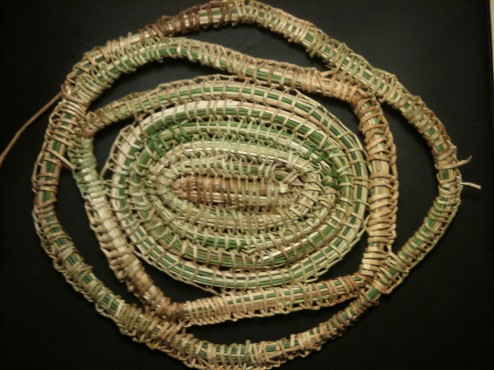
 Have you ever weaved a basket? I hadn’t… “Life’s too busy for arts and crafts…” or so I used to think. I was wrong. Weaving was more than relaxing and therapeutic, it embodied a metaphorical connection I was in dire need of.
I learned so so much during my weekend at Camp Coorong. I travelled there to discuss a book chapter that I co-authored with some of the Ngarrandjeri youth, transcribing their documentary Nukkan Kungun Yunnan – Narrindjeri’s Being Heard.
When my alarm went at 4:40am on Saturday morning I wondered why I agreed to the trip – didn’t I have enough on my plate? I made it on my 6:15am flight and arrived in Adelaide a couple of hours later.
Sitting for a coffee as I waited for my friend to pick me up, took a long deep breath. There was a stillness surrounding me. I had nothing to do. Intentionally leaving my books at home I realised why I was there, in Adelaide, visiting The Coorong. It wasn’t for the chapter.
It was for one reason: to listen.
I thought back over the week that had passed. I had been the most stressed I’d ever remember feeling in my entire life. While the run and writing from last Sunday’s blog entry helped me get the balls back in the air… on Monday they all came crashing down.
“How was your weekend?” ‘Wahhhhhhhh!”… and later … “Can we meet next Monday?” “Wahhhhhhh!” I burst into tears. Twice. For no reason at all. Now that is what I call STRESS.
No amount of yoga or running could cure it. But at Camp Coorong I felt a deeper change occur.
My friend picked me up, and we drove through Adelaide Hills, over the Murray River, and into Camp Coorong.
An air of serenity surrounded us.
A quiet peace. Time slowed down. And Ellen Trevorrow taught me to weave.
I weaved my life, my mind and my soul, into the creation you can see in the photo above.
And as I weaved, I listened and learned, as together a group of us “had a yarn”!!!
In the culture of Indigenous Australians one doesn’t ask questions. One doesn’t take turns answering. One doesn’t talk about things they don’t want to talk about. No. Instead, people tell stories.
Maybe it’s the weaving. As we weaved, the energy changed. The air lightened and gravity tightened.
I had never felt so grounded. And I had never felt so free.
In this conversation one shared information, stories, they wanted to share. And the rest of the time you listened.
On Saturday I heard some of the most fantastic love stories, and tales of the saddest tragedies. Each story was captured in my weave. Later that night I taught some of the other visitors what I’d learned. Children and adults, all weaving together. There was something magic about this activity, and about this place.
I could go on and on about the many things I learned and experienced. It was all so subtle. It’s difficult to explain. Even more difficult to explain is the incredible feeling of groundedness I still feel today. I have a feeling these things will influence me in ways I can’t yet imagine.
Instead of trying to imagine them now, I’m going to share my favourite story from the weekend and leave it with you to ponder. Surrounded by pre-school children listening intensely, Tom Trevorrow told this story.
This is the story of the Thukeri and the Bony Bream:
‘A long time ago two Ngarrindjeri men went fishing in a bay near Lake Alexandrina to catch the thukeri mami (bream fish). They set off in their bark canoe to catch the big fat thukeri. They fished and fished until their canoe was over full and they said,
“We have plenty of thukeri we will paddle to shore before we sink.”
As they paddled to shore they saw a stranger coming towards them so they covered up the thukeri with their woven mats they said this man might want some of our thukeri, when they approached the shore the stranger said to them,
“Hey brothers I’m hungry have you got any fish to share?”
But the two Ngarrindjeri men said,
“No we haven’t got many fish we only have enough to feed our families.”
So the stranger began to walk away then he turned and said,
“You have plenty of fish and because you are greedy and don’t want to share you will not enjoy the thukeri fish ever again.”
As the stranger walked away the two Ngarrindjeri men laughed at him.
When the two Ngarrindjeri men unloaded the thukeri on to the banks to scale and clean them, they saw that their nice big fat thukeri were bony and they didn’t know what had happened. The two Ngarrindjeri men went home to the campsite in shame and told the Elders what had happened.
The Elders were angry and said, “The stranger was Ngurunderi our Spirit Ancestor and because you two were greedy and would not share with him he has put a curse on our thukeri mami. Now all the Ngarrindjeri people will be punished.”
Respect, caring and sharing, don’t be greedy, and don’t tell lies. Otherwise everybody will get punished.’
This was just one of the many many amazing stories I heard and experienced at the Camp. If anyone has a chance to go visit and learn from the Ngarrandjeri people, I highly recommend the experience. There are many different ways to live and be in this world, and the more of them we can expose ourselves to, the more likely the way we choose to live our lives is actually a choice.
Visit the: Camp Coorong Website
Watch the short version of the doco: Nukkan [See]. Kungun [Listen]. Yunnah [Speak].
[youtube]http://www.youtube.com/watch?v=rGIsv-dSs40[/youtube]
Find the story of the Thukeri and the Bony Bream and other information here: hurrysavethemurray.com/wp…/ngarrindjeri-sea-country-plan.pdf
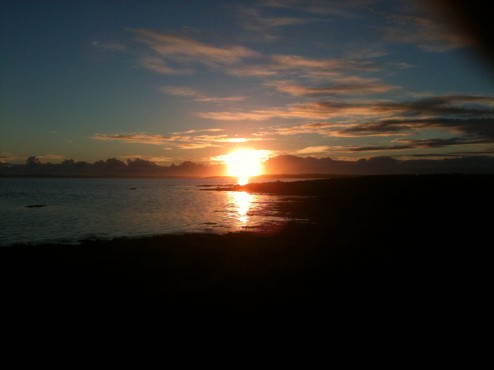
The sunset on The Coorong on Saturday:
Let us listen, and learn…
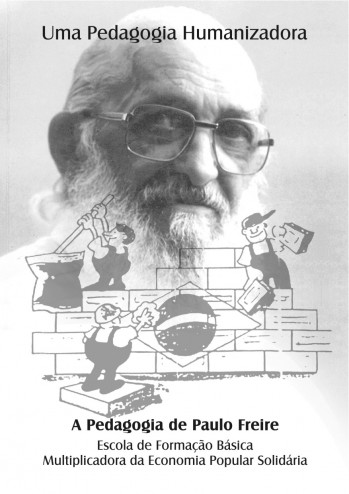 “The oppressors, who oppress, exploit, and rape by virtue of their power, cannot find in this power the strength to liberate either the oppressed or themselves. Only power that springs from the weakness of the oppressed will be sufficiently strong to free both.” (Paulo Freire, Pedagogy of the Oppressed, 1970: 21)
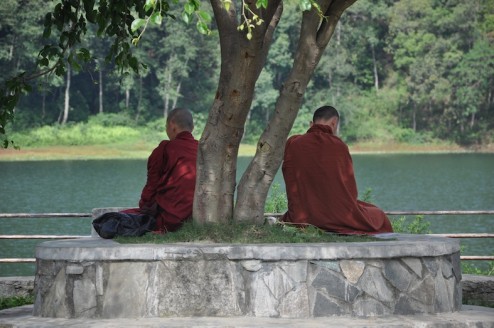 Have you ever picked up the phone to call a friend, only to find your friend calling you? Do you notice the moments of “synchronicity” when everything you do happens with ease, green lights all the way, the right song on the radio at just the right time?